
Key Takeaways
- The Port of Vancouver handles millions of TEUs annually, making proactive risk management essential for enterprise importers navigating complex global trade corridors.
- Relying on standard maritime carrier liability exposes your business to the $500 COGSA limit, capping your capital recovery at a microscopic fraction of your actual cargo value.
- Vancouver Port Congestion requires strategic foresight, including digitized documentation and continuous financial protection during extended terminal dwell times.
- ShipSimple empowers Canadian shippers with automated All-Risk Shipper’s Interest Insurance, offering CIF + 10% valuation when elected at booking to restore liquidity rapidly.
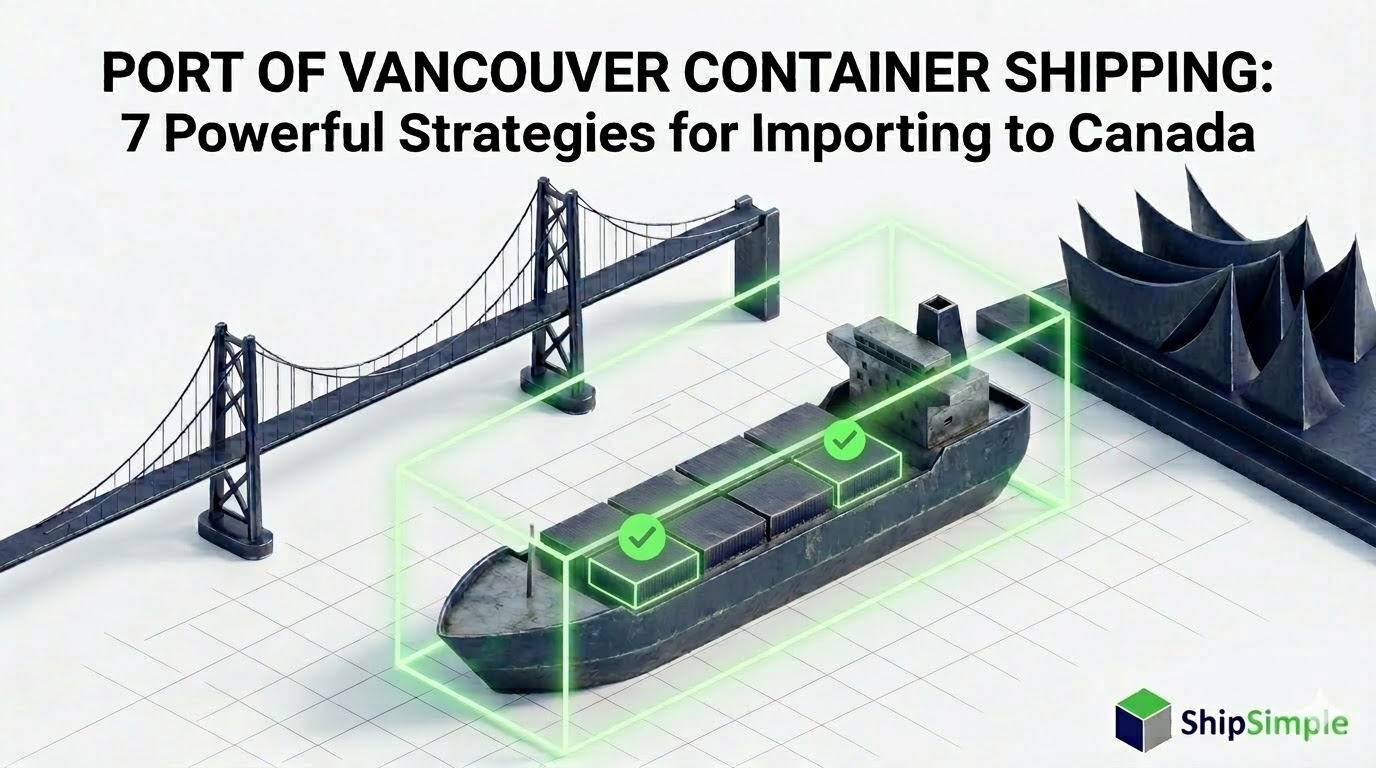
The Port of Vancouver is Canada’s largest maritime gateway, processing millions of TEUs annually to connect North American enterprise importers with critical Indo-Pacific trade corridors. Navigating this massive operational volume requires strategic foresight, as facilities manage complex geopolitical shifts and robust artificial demand surges. For prepared shippers, this high-velocity baseline presents distinct opportunities to outpace competitors and secure vital supply chains while mitigating severe financial exposure.
The primary disruptor in modern maritime logistics is strategic front-loading. To outmaneuver volatility surrounding international trade agreements and tariff fluctuations, forward-thinking enterprise importers aggressively accelerate their inventory arrivals. This proactive buffering effectively eliminates the traditional slack season, creating high-density yard conditions that test the limits of terminal infrastructure. For the astute supply chain executive, this high-density environment at the Port of Vancouver is not a deterrent. It is a calculated opportunity to engineer a supply chain that absorbs operational friction and maintains product availability.
Importers who rely on outdated, manual logistics workflows experience volatile transit times and severe financial exposure. Conversely, businesses that implement digitized Container Shipping documentation, secure priority intermodal rail routing, and use automated Ocean Cargo Insurance seamlessly navigate these volume surges. By understanding the immense scale of the terminal operations, you can proactively safeguard your corporate bottom line before the vessel even departs its origin port.
Fact Block: The Scale of Western Maritime Trade
- Volume Baseline: The Port of Vancouver handled approximately 3.1 million TEUs in 2023, acting as the primary artery for Canadian maritime commerce.
- The Liability Cap: The Carriage of Goods by Sea Act legally caps standard ocean carrier liability at exactly $500 per customary freight unit).
- Domestic Transit Limits: Once cargo transfers to domestic rail or road, standard carrier liability shifts to $4.41 per kilogram ($2 per pound) on a standard bill of lading, unless a higher value is declared.
- Theft Escalation: Cargo theft across North America has surged, with Verisk CargoNet reporting massive year-over-year increases in targeted supply chain attacks.
Why Do I Need Shipping Insurance When Importing to Canada by Sea?
You need shipping insurance when Importing to Canada by Sea because standard maritime law severely limits ocean carrier financial responsibility during transit. Without comprehensive private coverage, you remain personally liable for catastrophic financial losses during extreme weather events, complex intermodal transfers, and severe terminal congestion.
Many executives operate under the dangerous assumption that simply paying a premium to a premier ocean carrier secures the financial safety of their freight. This is a fundamental misunderstanding of international maritime law. When using the Port of Vancouver for your primary logistics gateway, your cargo is subjected to an incredibly complex, multi-modal journey. Your goods must survive the unpredictable physics of the open ocean, the high-impact crane transfers at the terminal, and the rigorous vibrations of inland rail transit.
Without dedicated Ocean Cargo Insurance, you are fully exposed to General Average. This is an internationally recognized maritime law where all parties involved in a sea voyage proportionally share any losses resulting from a voluntary sacrifice of part of the ship or cargo to save the whole in an emergency. If a vessel bound for the Port of Vancouver catches fire and the captain jettisons containers to save the ship, you are legally required to pay a proportional share of that loss, even if your specific container arrives in perfect condition.
The carrier will place a strict maritime lien on your cargo, forcing you to pay tens of thousands of dollars out of pocket just to release your goods. Securing an independent Ocean Freight 2026 policy entirely eliminates this catastrophic financial exposure by absorbing the General Average bond on your behalf, preserving your vital operational cash flow.
How Does the $500 COGSA Limit Impact Container Shipping?
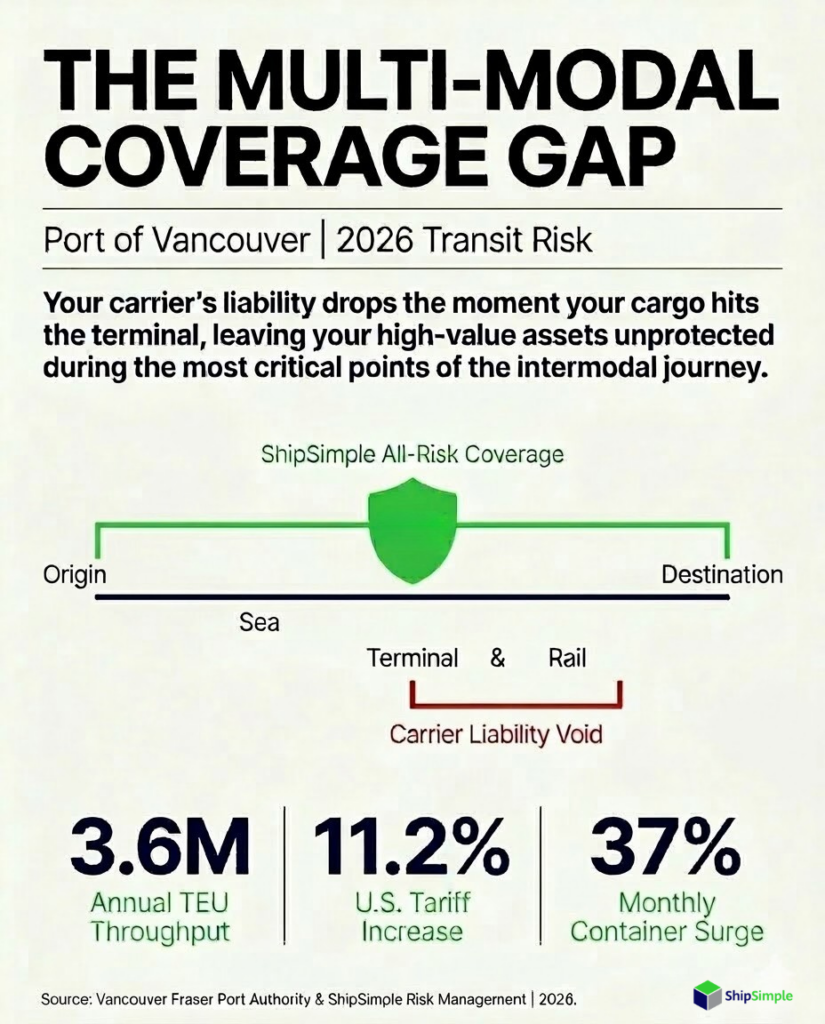
The $500 COGSA limit impacts Container Shipping by legally capping an ocean carrier’s liability at exactly $500 per customary freight unit. This archaic legislation leaves enterprise importers to absorb massive financial losses if high-value assets are destroyed or lost at sea, unless they secure independent coverage.
The Carriage of Goods by Sea Act is the most significant financial hurdle in global maritime logistics. Yet, shippers who understand the legal framework easily navigate it. Most mid-market businesses executing Port of Vancouver supply chain strategies are completely unaware that their ocean carrier’s financial responsibility is microscopic compared to the actual commercial value of their goods. A single TEU navigating through terminal logistics often holds hundreds of thousands of dollars in specialized industrial machinery or high-end consumer packaged goods.
If that container is lost overboard or irreparably damaged during a crane transfer, relying solely on basic carrier liability is a devastating strategic miscalculation. Under COGSA, the shipper must definitively prove that the ocean carrier’s direct negligence caused the damage. This is a near-impossible feat when your freight has been handled by foreign drayage, ocean vessels, port terminal operators, and domestic rail networks. Empowered executives neutralize this trap entirely by securing automated, third-party Ocean Cargo Insurance, which covers the declared commercial value of the freight without requiring proof of carrier fault.
How Can Importers Overcome Vancouver Port Congestion?
Importers overcome Vancouver Port Congestion by digitizing customs documentation, securing priority intermodal rail routing, and maintaining continuous financial protection during extended terminal dwell times. While systemic gridlock introduces variables outside a standard operator’s control, proactive supply chain managers engineer workflows that absorb operational friction.
While Vancouver Port Congestion is a reality driven by macro-economic front-loading, it does not have to severely disrupt your profitability. The immediate byproduct of high terminal volume is a reduction in velocity, leading to extended vessel dwell time. This is the period where goods remain static on the tarmac. The Port of Vancouver operates at peak efficiency when cargo is perpetually moving, but heavy yard density forces high-value cargo to sit exposed to the elements for extended durations.
It is critical to understand that delay is an absolute exclusion under all cargo policies, ShipSimple’s included. No insurance policy pays for lost revenue, market share, or operational downtime caused by a delayed vessel. However, maintaining active Ocean Cargo Insurance during these stationary periods protects the physical assets against theft, mysterious disappearance, or impact damage while they sit in the yard. When Importing to Canada by Sea, protecting your valuable goods while they are static is the exact same priority as protecting them while they are actively sailing the Pacific.
How Do Inland Rail Networks Connect to the Port of Vancouver?
Inland rail networks connect to the Port of Vancouver through highly sophisticated intermodal transfer facilities where ocean containers are lifted directly onto domestic rail cars. This immediate transition from terminal staging yards to intricate rail corridors requires flawless execution to prevent severe transit damage.
The strategic power of the Port of Vancouver lies not just in its deep-water ocean access, but in its unparalleled intermodal connectivity to the North American interior. Once your cargo clears customs, the massive logistical journey transitions from the ocean to the continent. This requires immediate transfer from the terminal staging yards to the intricate intermodal rail networks operated by CN Rail and CPKC. To navigate this surging volume and secure highly competitive pricing, elite shippers partner with ShipSimple’s sister company, RailGateway, which specializes exclusively in intermodal rail shipping.
However, the physical process of lifting a fully loaded TEU from a staging yard and securing it to a rail car introduces severe physical risks. When a massive gantry crane moves a container, scratching, denting, marring, and chipping (SDMC) are excluded under standard cargo insurance, ShipSimple’s included, unless caused by an insured peril like a dropped container or a derailment. Similarly, damage resulting from poor blocking and bracing inside the container is considered insufficient packing, which is an absolute exclusion under all policies.
Once the container is on the rail network, standard domestic carrier liability applies. This limits recovery to $4.41 per kilogram ($2 per pound) on a standard bill of lading, unless a higher value is declared. Securing true door-to-door Intermodal Freight Shipping coverage means your Port of Vancouver freight is financially protected across all modes of multi-carrier transit, bypassing these weight-based domestic caps.
What Role Does a Freight Forwarder Play in Ocean Cargo Insurance?
A freight forwarder coordinates the physical movement of your goods but relies on standard carrier liability, making independent Ocean Cargo Insurance essential for full financial protection. Their mandate is to secure your routing and handle international customs paperwork, not to underwrite the commercial value of your cargo.
Partnering with an elite freight forwarder is one of the most powerful strategies an importer can leverage to support Port of Vancouver success. These professionals possess deep, localized knowledge of terminal operations, carrier schedules, and Canadian Border Services Agency compliance regulations. When you are Importing to Canada by Sea, your forwarder is the operational engine driving the physical movement of your goods.
A critical component of executive logistics management is understanding the distinct separation between operational execution and financial liability. A freight forwarder operates under strict international terms and conditions that explicitly limit their financial liability to fractions of pennies on the dollar, directly mirroring the legal limitations of the physical ocean carriers. By intentionally pairing the operational brilliance of your forwarder with the financial protection of an independent insurance platform, you help keep your Port of Vancouver operations both perfectly executed and financially secured.
Carrier Liability vs. ShipSimple: What Are the Key Differences?
The key difference is that carrier liability caps payouts by weight and requires proving negligence, whereas ShipSimple pays on proof of loss without requiring you to prove carrier fault. Standard maritime liability is legally engineered to protect global shipping lines, while private coverage is strictly engineered to make the Canadian importer whole.
Mastering the mechanics of Carrier Liability vs All-Risk Insurance is the foundational bedrock of profitable modern maritime logistics. In the high-stakes realm of Port of Vancouver imports, understanding this specific distinction empowers businesses to scale without fear of catastrophic financial ruin.
Strategic Snapshot: Financial Empowerment Comparison
| Logistical Event | Carrier Liability (COGSA / Domestic Limits) | ShipSimple All-Risk Empowerment |
|---|---|---|
| Valuation Basis | Capped at $500 per unit (ocean) or $2/lb (domestic) | Invoice product cost, or CIF + 10% recommended, elected when you book |
| What You Need to Claim | Proof the carrier was negligent | Photos and a description of the damage (for freight, plus a repair estimate or third-party confirmation), or tracking showing non-delivery once the carrier’s waiting period has passed, with no need to prove carrier negligence |
| Claim Resolution Time | Can take months | Under 30 days for approved submissions |
| Shared Exclusions (e.g., SDMC, ROD) | Denied entirely | Excluded unless caused by an insured peril |
| General Average Declaration | Importer pays cash out of pocket to release cargo | Private policy fully absorbs the maritime lien |
When analyzing these differences within the context of Container Shipping, the path to profitability is undeniable. Replacing standard carrier tariffs with an independent, high-limit private policy is the most mathematically sound decision an executive team can make to protect their balance sheet.
How Does ShipSimple Protect Your Port of Vancouver Operations?
ShipSimple protects your Port of Vancouver operations by providing an automated platform for All-Risk Shipper’s Interest Insurance, valuing goods at CIF + 10% when elected at booking. Backed by one of North America’s largest commercial underwriters, this coverage completely replaces outdated maritime limitations with robust financial security.
As Canada’s only automated shipping insurance platform, ShipSimple fundamentally elevates how businesses secure their complex international supply chains. With over 20 years of deep logistics experience embedded into our proprietary software technology, we have engineered a solution specifically designed to optimize Container Shipping into the Port of Vancouver. Through a simple three-step workflow (Product Details, Shipment Details, Address Details), executives secure coverage instantly, entirely avoiding convoluted manual paperwork.
Your Port of Vancouver operations are fiercely guarded by world-class, CNA-backed underwriting. We provide an All-Risk Shipper’s Interest Insurance policy meticulously tailored for global ocean freight. We offer standard limits up to $500k for freight, with significantly higher custom limits readily available on a per-customer basis upon review.
Industrial Machinery and Specialized Freight
For enterprise importers bringing in heavy industrial equipment, specific class conditions apply. Industrial machinery is subject to a deductible of 1% of the total insured value, with a minimum of $500. Coverage requires containerized shipments, and there is no risk covered while the machinery is under its own power, other than during direct loading and unloading. Used equipment is subject to a Used Machinery Clause.
Mechanical and electrical derangement (M&ED) is a major concern for complex equipment. If a CNC machine arrives looking perfectly intact but fails to power on, that internal failure is excluded under standard cargo insurance, ShipSimple’s included, unless caused by an insured peril such as a collision or overturn. Coverage applies to physical transit events, not inherent vice or ordinary wear and tear.
Crucially, our policy pays irrespective of exactly who is responsible for the physical loss or damage. There is no need to prove fault on the part of the ocean carriers, inland rail operators, or Port of Vancouver terminal staff. Should a maritime incident occur, claims are submitted directly through our digital portal, coordinated with an adjuster to resolve approved submissions in under 30 days.
What 7 Actionable Steps Protect Your Port of Vancouver Supply Chain?
To protect your Port of Vancouver supply chain, you must decouple logistics from insurance, audit Incoterms, digitize documentation, secure door-to-door coverage, demand proper valuation, mitigate intermodal risks, and prepare for General Average. Implementing these proactive strategies transforms a massive logistical vulnerability into a heavily guarded financial asset.
Supply chain optimization requires immediate, highly technical execution. To properly secure your corporate assets as they navigate the immense scale of the Port of Vancouver, you must implement these seven proactive strategies:
- Decouple Logistics Execution from Insurance: Never rely on the standard operating terms of your freight forwarder to act as your ultimate financial safety net. Secure independent Ocean Cargo Insurance to officially separate your physical logistics execution from your overarching financial protection strategy.
- Audit Your Incoterms Rigorously: Verify that your coverage flawlessly triggers the exact moment financial risk transfers to your corporate ledger when Importing to Canada by Sea. Know definitively whether you are shipping CIF, FOB, or EXW, and insure accordingly.
- Implement Digital Documentation Protocols: In the event of a severe maritime claim, having highly organized, high-resolution origin photos, digitized packing slips, and precise commercial invoices allows the automated platform to process your financial payout with maximum velocity.
- Secure True Door-to-Door Coverage: Do not settle for minimum port-to-port maritime policies. Verify your Port of Vancouver coverage extends explicitly through the inland rail journey, safely protecting your goods until they reach their final Canadian warehouse. Note that door-to-door coverage must be declared as such at booking, subject to country restrictions.
- Demand True Value Protection: Reject standard weight-based ocean carrier tariffs entirely. Verify your private policy values your goods at CIF + 10% when elected at booking, helping you recover all associated logistical costs in the event of a total marine loss.
- Mitigate Intermodal Transfer Risks: Recognize that the transition from ocean vessel to domestic rail is a high-risk event. Verify your cargo is professionally blocked and braced inside the container, as damage from shifting loads is considered insufficient packing and is an absolute exclusion under all policies.
- Prepare for General Average Declarations: Understand that a maritime emergency can result in a massive financial lien against your cargo. Securing an independent policy means that the insurer absorbs the General Average bond, allowing your goods to be released without draining your operational cash flow.
By systematically abandoning reliance on basic carrier liability and aggressively adopting specialized Container Shipping insurance, you rapidly secure your capital against the unpredictable variables of international trade.
How Do You Master Port of Vancouver Logistics in 2026?
You master Port of Vancouver logistics in 2026 by abandoning reliance on outdated carrier liability caps and implementing automated, all-risk financial protection for your high-value freight. As global trade variables evolve and massive container volumes push intermodal networks to their limits, proactive risk mitigation is a mandatory executive strategy.
The incredible scale and complexity of the Port of Vancouver demand a radically proactive approach to financial risk management. Relying on outdated, limited maritime laws like COGSA is no longer a viable modern business strategy. The catastrophic $500 liability cap, the sheer financial unpredictability of General Average declarations, and the rigorous multi-modal physics of inland rail transfers require a robust, specialized solution.
By taking decisive action and implementing automated Ocean Cargo Insurance, ambitious importers firmly reclaim control over their financial destiny. ShipSimple provides the exact technological software infrastructure required to master these supply chain channels. Protecting your capital is not just about moving steel boxes across the ocean; it is about making sure that no matter what complex variables arise during Vancouver Port Congestion, your business remains profoundly secure.
- Get an Instant Shipping Insurance Quote Now
- Learn More About Our All-Risk Damage, Loss, & Theft Coverage
- Contact Our Experts to Secure Your 2026 Shipments
Additional Resources
- Learn More About ShipSimple’s All-Risk Shipping Insurance
- ShipSimple’s Freight & Marine Cargo Shipping Insurance
- ShipSimple’s Parcel Shipping Insurance
- More Helpful Blogs
Frequently Asked Questions
Why is Ocean Cargo Insurance necessary for Port of Vancouver imports?
Standard maritime law severely limits ocean carrier financial responsibility during transit. Without comprehensive private coverage, you remain personally liable for catastrophic financial losses during extreme weather events, complex intermodal transfers, and severe terminal congestion.
How does the $500 COGSA limit affect Container Shipping?
The Carriage of Goods by Sea Act legally caps an ocean carrier’s liability at $500 per customary freight unit. This legislation leaves enterprise importers to absorb massive financial losses if high-value assets are destroyed or lost at sea.
Can importers protect their goods during Vancouver Port Congestion?
Maintaining active Ocean Cargo Insurance during stationary periods protects physical assets against theft, mysterious disappearance, or impact damage while they sit in the yard. However, delay itself is an absolute exclusion under all cargo policies, ShipSimple’s included, meaning lost revenue from delayed vessels is not covered.
What is the deductible for industrial machinery shipped through the Port of Vancouver?
Industrial machinery is subject to a deductible of 1% of the total insured value, with a minimum of $500. Coverage requires containerized shipments, and there is no risk covered while the machinery is under its own power, other than during direct loading and unloading.