
Determining which of the Institute Cargo Clauses is best for your ocean freight comes down to selecting Clause A for comprehensive all-risk coverage, rather than the restrictive named perils of Clauses B or C. By securing Institute Cargo Clauses A, shippers guarantee total protection against physical loss or damage, ensuring absolute financial security across the turbulent global supply chain.
Key Takeaways
- The Default is Dangerous: Most global shipments default to Institute Cargo Clauses C, leaving shippers exposed to massive financial liabilities from theft, handling damage, and extreme weather.
- The Regulatory Trap: Without comprehensive Marine Cargo Insurance Canada, shippers are bound by severe weight-based liability limits under Canada’s Marine Liability Act, which can pay less than 1% of the cargo’s true value.
- The Geopolitical Threat: Escalating global conflicts, such as the Red Sea crisis, are not covered under basic policies. All-risk coverage, including War and SR&CC clauses, is now mission-critical.
- The Optimal Choice: Upgrading to the All-Risk tier of the Institute Cargo Clauses (Clause A) provides full protection. ShipSimple.ca provides the equivalent of Clause A coverage automatically.
- The Automated Solution: ShipSimple.ca is Canada’s only automated shipping insurance platform, delivering instant, high-limit protection backed by CNA Canada to bypass 30+ day traditional claims processes.
The 2026 Ocean Freight Risk Landscape
- Geopolitical Impact: Attacks in the Red Sea have caused shipping volumes to plummet by 70% and insurance premiums to spike by over 500% in high-risk zones, making War Clauses essential. (Source: International Monetary Fund)
- Intermodal Vulnerability: Ocean freight moving through Cargo Insurance Port of Vancouver touchpoints faces a 40% higher risk of handling damage during rail transfer to CN Rail or CPKC. (Source: Canadian International Merchandise Trade Database)
- Liability Caps: According to 2026 Canadian border shipping regulations, weight-based liability restricts carrier payouts to just 2 Special Drawing Rights (SDR) per kilogram (approx. $3.50 CAD), voiding actual commercial value recovery. (Source: The Marine Liability Act, Canada)
- Theft Hotspots: Cargo theft at unsecured lots and warehouses in Canada rose by 59% in 2023, with the Greater Toronto Area accounting for 40% of all reported incidents. (Source: Verisk CargoNet)
The Named Peril Trap
As of 2026, data from major Canadian ports shows that nearly 30% of trans-Pacific shipments suffer ‘partial loss’ due to extreme weather and port congestion. Shippers relying on ICC Clause C – the default for most Incoterms 2020 CIF Insurance agreements – often find themselves unprotected against ‘Moisture Damage’ and ‘Theft,’ risks that are significantly rising at major intermodal hubs in Ontario and BC. Relying on inadequate Institute Cargo Clauses threatens modern supply chains at their core.
What Are the Institute Cargo Clauses?
The Institute Cargo Clauses are internationally recognized marine insurance standards that define the exact perils covered during transit. They are divided into Clauses A, B, and C, dictating whether shipments are protected against comprehensive all-risks or a strictly limited list of named perils.
To master ocean freight logistics, executives must understand that the Institute Cargo Clauses form the absolute backbone of global trade protection. Originally drafted by the International Underwriting Association of London, they dictate the parameters of Marine Cargo Insurance Canada policies and international transit coverage alike. Shippers who ignore the fine print of the Institute Cargo Clauses frequently face devastating uninsured losses.
Institute Cargo Clauses C (Basic Named Perils)
This lowest tier of the Institute Cargo Clauses provides highly restricted coverage. It only protects ocean freight from catastrophic named perils such as a vessel sinking, stranding, or colliding. It strictly excludes theft, malicious damage, and water damage (unless caused by the vessel sinking). For any business shipping high-value assets, relying on Clause C is an extreme operational vulnerability.
Institute Cargo Clauses B (Broad Named Perils)
The middle tier slightly expands the list of covered disasters. It adds protection against earthquake, volcanic eruption, and the washing overboard of cargo. However, like Clause C, this version of the Institute Cargo Clauses remains a named-peril policy. If the cause of the loss is not explicitly listed, the claim will be denied.
Institute Cargo Clauses A (All Risk)
Clause A represents the gold standard. Unlike the lower tiers, Institute Cargo Clauses A provides an “All Risks” framework. This means that unless a risk is specifically excluded in the policy (such as inherent vice or delay), the ocean freight is fully covered for physical loss or damage. ShipSimple.ca leverages the equivalent of this top-tier protection, delivering an all-risk Marine Cargo Insurance Canada policy that ensures full financial recovery. When analyzing All Risks vs Named Perils, this is the only logical choice for executive risk mitigation.

Why Is All Risks vs Named Perils Crucial for Ocean Freight?
Choosing All Risks vs Named Perils is crucial for Ocean Freight because named perils only cover specifically listed disasters, leaving massive protection gaps. All-risk coverage protects against unpredictable physical loss or damage, including theft and handling damage, shielding your bottom line from catastrophic financial exposure.
In the complex ecosystem of Marine Cargo Insurance Canada, the debate between All Risks vs Named Perils dictates your ultimate financial survival. Transport Canada (TC) and its Oceans Protection Plan heavily regulate vessel safety, but physical cargo damage at major hubs like Prince Rupert and the Port of Montreal remains a statistical certainty. A 2023 report from the National Cargo Security Council highlighted a significant increase in “hostile surveillance” at Canadian ports, a precursor to organized cargo theft. Relying on named perils leaves you completely exposed to this rising threat.
Through ShipSimple.ca’s automated dashboard, securing this all-risk Marine Cargo Insurance Canada protection becomes instantaneous. Shippers bypass the dangerous guessing game of All Risks vs Named Perils by defaulting to comprehensive protection. By leveraging ShipSimple.ca’s all-risk coverage, executives protect their balance sheets from the unpredictable reality of modern logistics.
The Containerization Paradox: Why Larger Ships Increase Systemic Insurance Risk
Modern containerization has transformed global trade efficiency, but it has simultaneously introduced an unprecedented “accumulation risk” that traditional logistics strategies fail to account for. Over the past two decades, the capacity of container ships has more than doubled, with Ultra Large Container Ships (ULCS) now capable of carrying over 24,000 TEUs. While this scale drives down cost-per-unit, it concentrates staggering financial value – often reaching hundreds of millions of dollars in cargo – onto single, vulnerable hulls.
For the marine insurance industry, this concentration creates a systemic paradox.[1] On one hand, modern vessels are technologically advanced and safer than their predecessors. On the other, the sheer scale of the potential loss is exponential. A single incident – such as an onboard fire, a grounding, or a collision – now results in claims that dwarf historic norms. When an ULCS experiences a catastrophic event, the complexity of salvage, wreck removal, and environmental liability often spills into the billions of dollars.[2] This systemic risk is exactly why underwriters are increasingly cautious about capacity and why cargo owners must ensure their own interests are shielded by comprehensive Institute Cargo Clauses A coverage.
Furthermore, this accumulation risk extends into ports and intermodal hubs. When massive vessels arrive, they overwhelm terminal infrastructure, leading to inevitable port congestion, container bunching, and extended dwell times. During these periods, cargo remains exposed in stacks where theft, moisture ingress, and handling damage risks are magnified. This congestion is no longer a temporary disruption; it is the new structural baseline of 2026 global trade.[3] Shippers who rely on basic, named-peril policies are effectively underwriting the carrier’s inability to navigate this volatile environment themselves. By leveraging ShipSimple‘s platform, you shift this burden, ensuring that your individual inventory value is ring-fenced from the systemic failures and insurance bottlenecks created by the containerization paradox.
How Do Incoterms 2020 CIF Insurance Rules Impact Your Coverage?
Incoterms 2020 CIF Insurance rules impact your coverage by legally requiring the seller to provide only minimum protection under Institute Cargo Clauses C. This default named-peril framework leaves buyers exposed to severe financial loss from theft, water damage, and handling drops.
When negotiating international trade contracts, understanding Incoterms 2020 CIF Insurance is non-negotiable. “Cost, Insurance, and Freight” (CIF) mandates that the seller procures insurance for the buyer’s ocean freight. However, a critical flaw exists: the seller is only obligated to purchase the cheapest, most restrictive coverage – specifically Institute Cargo Clauses C.
This creates a massive blind spot. A buyer might assume their ocean freight is fully protected, only to discover the default Incoterms 2020 CIF Insurance excludes water ingress or theft during drayage operations. The financial pain point here is catastrophic underinsurance orchestrated by regulatory defaults. ShipSimple.ca offers the ultimate gain creator for this pain point. Instead of relying on the minimums dictated by Incoterms 2020 CIF Insurance, buyers and sellers can utilize ShipSimple.ca‘s platform to secure all-risk coverage instantly with an Insurance Valuation of CIF+10%, ensuring not only the goods and freight are protected, but an additional 10% is provided to cover the administrative burden of replacement.
How Do Geopolitical Risks Affect Your Cargo Insurance?
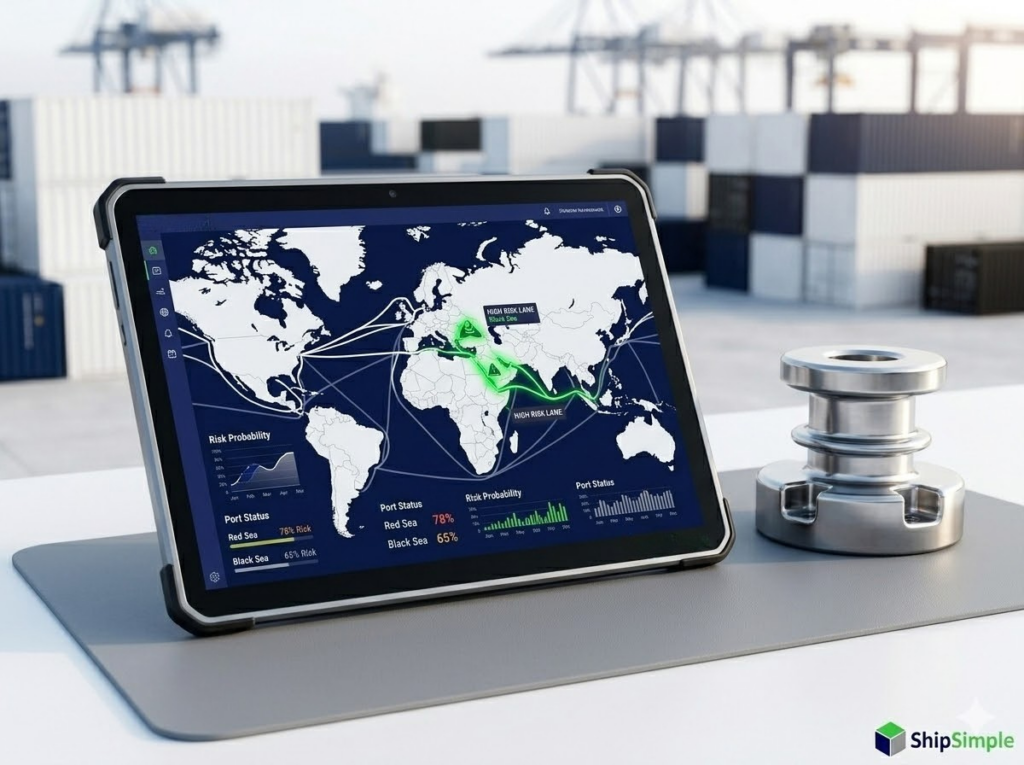
Geopolitical risks, such as military conflicts and piracy, are standard exclusions in basic cargo policies, meaning a loss from a war-related event will result in zero payout. To be protected, your policy must be endorsed with specific War and Strikes, Riots, and Civil Commotions (SR&CC) clauses.
The current global landscape is a minefield for supply chains. The Houthi attacks on commercial vessels in the Red Sea, as documented by the U.S. Office of Naval Intelligence, have made the Suez Canal a high-risk zone. Similarly, the ongoing conflict in Ukraine affects Black Sea shipping. Standard Institute Cargo Clauses B and C offer no protection against these events. Even Clause A requires additional endorsements.
This is a critical area where ShipSimple.ca provides immense value. Our all-risk policies are designed for the modern world and automatically include coverage for Acts of God, terrorism, war, strikes, and riots. This built-in protection means you don’t have to worry about sourcing separate, expensive endorsements. Your ocean freight is protected, warehouse-to-warehouse, regardless of global instability.
How Does the Marine Liability Act Limit Carrier Payouts?
The Canadian Marine Liability Act limits carrier payouts by legally capping ocean freight liability at 2 Special Drawing Rights (SDR) per kilogram. Without true shipper’s interest insurance, recovering the actual commercial value of lost or damaged goods is mathematically impossible.
When discussing Marine Cargo Insurance Canada, one must confront the severe limitations imposed by federal law. Marine Liability Act cargo claims are notoriously complex and heavily favor the vessel owner. If a shipping line’s Authorized Representative (AR) successfully argues that the carrier is not grossly negligent, the shipper’s recovery is artificially capped.
At approximately $3.50 CAD per kilogram, a 500-kilogram shipment of high-end electronics worth $150,000 would yield a maximum payout of less than $2,000 under the Act. This is a primary reason why relying on carrier liability is an unacceptable risk. This carrier stonewalling is completely bypassed by ShipSimple.ca. By providing true Shipper’s Interest coverage aligned with the highest tier of the Institute Cargo Clauses, ShipSimple ensures the policy pays irrespective of who is responsible. With automated limits of $500k for Freight (and higher limits available on a customer basis), we protect your actual inventory value, completely neutralizing the threat of weight-based liability caps.
Why Choose ShipSimple.ca for Your Ocean Freight Coverage?
You should choose ShipSimple for your ocean freight coverage because it is Canada’s only automated shipping insurance platform. Offering automated limits up to $500,000 for freight (with higher limits available upon request) backed by CNA Canada, it bypasses carrier stonewalling with instant, digital claims resolutions.
The traditional landscape of Marine Cargo Insurance Canada is plagued by analog inefficiencies. Filing a claim through a carrier often takes over 30 days, only to end in denial based on obscure liability terms. With over 20 years of combined logistics experience, our team built ShipSimple to eliminate this pain point. Through our automated dashboard, claims are submitted seamlessly with all required documentation and images, coordinating directly with an adjuster from CNA Canada.
Whether your goods are entering the domestic network via Purolator or moving as heavy freight across the Pacific, ShipSimple ensures the policy pays irrespective of who caused the damage. We automatically provide the equivalent of Institute Cargo Clauses A, so you no longer have to navigate the All Risks vs Named Perils debate – ShipSimple shields your revenue with comprehensive, high-limit, globally compliant coverage.
Institute Cargo Clauses Comparison
| Clause Level | Coverage Type | Key Protections | Key Exclusions & Geopolitical Gaps | Best Suited For |
| Institute Cargo Clauses C | Basic Named Perils | Vessel sinking, fire, collision | Theft, water damage, partial loss, war, strikes | Low-value bulk commodities (e.g., scrap metal) |
| Institute Cargo Clauses B | Broad Named Perils | Earthquakes, washing overboard | Theft, non-delivery, handling damage, war, strikes | Mid-value goods highly resistant to physical impact |
| Institute Cargo Clauses A | All Risks | All physical loss/damage (unless excluded) | Delay, inherent vice, inadequate packing | High-value, manufactured goods and delicate electronics |
Frequently Asked Questions
What are the Institute Cargo Clauses?
The Institute Cargo Clauses are global marine insurance frameworks defining coverage levels. Clause C is basic “named perils,” while Clause A is comprehensive “all-risks,” which is the standard offered by ShipSimple.ca.
Does Marine Cargo Insurance Canada cover theft?
Only if you select “All Risk” coverage (Institute Cargo Clauses A). If you rely on basic carrier liability or Clause C, theft and pilferage are strictly excluded from your policy. ShipSimple.ca covers theft.
What is the difference between All Risks vs Named Perils?
All Risks policies cover any physical loss or damage unless specifically excluded. Named Perils policies only cover disasters explicitly listed, leaving the shipper exposed to countless unlisted risks like common theft or handling damage.
Does cargo insurance cover war and geopolitical events?
Basic policies (Clauses B and C) do not. All-risk policies like those from ShipSimple.ca include coverage for war, strikes, riots, and terrorism, which is critical given the current global landscape.
How much insurance does ShipSimple offer for ocean freight?
ShipSimple.ca provides automated limits up to $500,000 for freight. We can provide higher limits on a customer-by-customer basis to ensure your high-value shipments are fully protected.
Securing Your Assets with the Right Institute Cargo Clause
The choice between Institute Cargo Clauses A, B, and C is not a matter of preference; it is a critical executive decision with direct consequences for your company’s financial stability. Relying on the default Clause C or the limited protection of carrier liability is an explicit acceptance of catastrophic risk in a world defined by port congestion, geopolitical volatility, and rising cargo theft. The only strategically sound choice is to secure comprehensive, all-risk coverage under Institute Cargo Clauses A. This single decision transforms your ocean freight from a high-risk liability into a fully protected asset, from warehouse to warehouse.
ShipSimple.ca was built to make this critical choice the default standard. Our automated platform eliminates the guesswork and administrative burden, instantly providing the equivalent of Clause A protection for every shipment. By leveraging our technology, you bypass the inherent flaws in the global shipping framework and ensure your cargo’s full value is protected by A+ rated underwriting from CNA, irrespective of carrier fault.
- Get an Instant Shipping Insurance Quote Now
- Learn More About Our All-Risk Damage, Loss, & Theft Coverage
- Contact Our Experts to Secure Your 2026 Shipment