
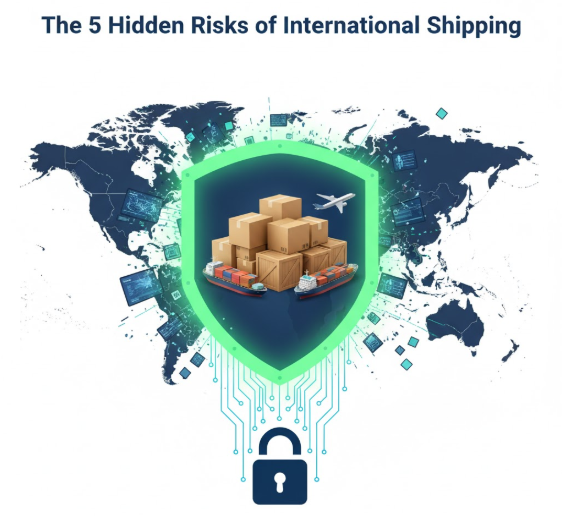
The Reality of International Shipping: Why Your Cargo Is at Risk
Global logistics is a modern miracle, but for the package itself, it is a gauntlet of risk.
When you hand off an international shipment, you are sending your inventory into a complex, high-friction network that is entirely out of your control. Your package doesn’t just go from Point A to Point B. It passes through a chaotic chain of custody involving roughly 20 different touchpoints.
It moves from your temperature-controlled warehouse to a vibrating truck, onto a forklift, through an aggressive automated sorting system, into an unpressurized airplane cargo hold, through the hands of a foreign customs agent, and onto a final delivery van.
Now, ask yourself the uncomfortable questions:
- What happens if a forklift pierces the box at a transfer hub in Frankfurt?
- What happens if the entire pallet “mysteriously disappears” at a sorting facility in Memphis?
- What happens if the ship encounters a storm and your container is tossed overboard to save the vessel?
If you are running a business, you likely assume you have a safety net. You might look at the “Declared Value” field on your shipping label and think, “If anything happens, the carrier has me covered.”
This assumption is one of the single biggest financial risks a modern business can take.
There is a massive, costly gap between what you think happens when a package is lost, and what actually happens when you file a claim with a carrier. Relying on the carrier’s “included” protection isn’t a strategy; it is a gamble with your revenue, your cash flow, and your customer’s trust.
In this guide, we are going to strip away the industry jargon and expose the reality of international shipping. We will break down the top 5 hidden risks that threaten your supply chain and explain the critical, wallet-saving difference between basic carrier liability and real shipping insurance.
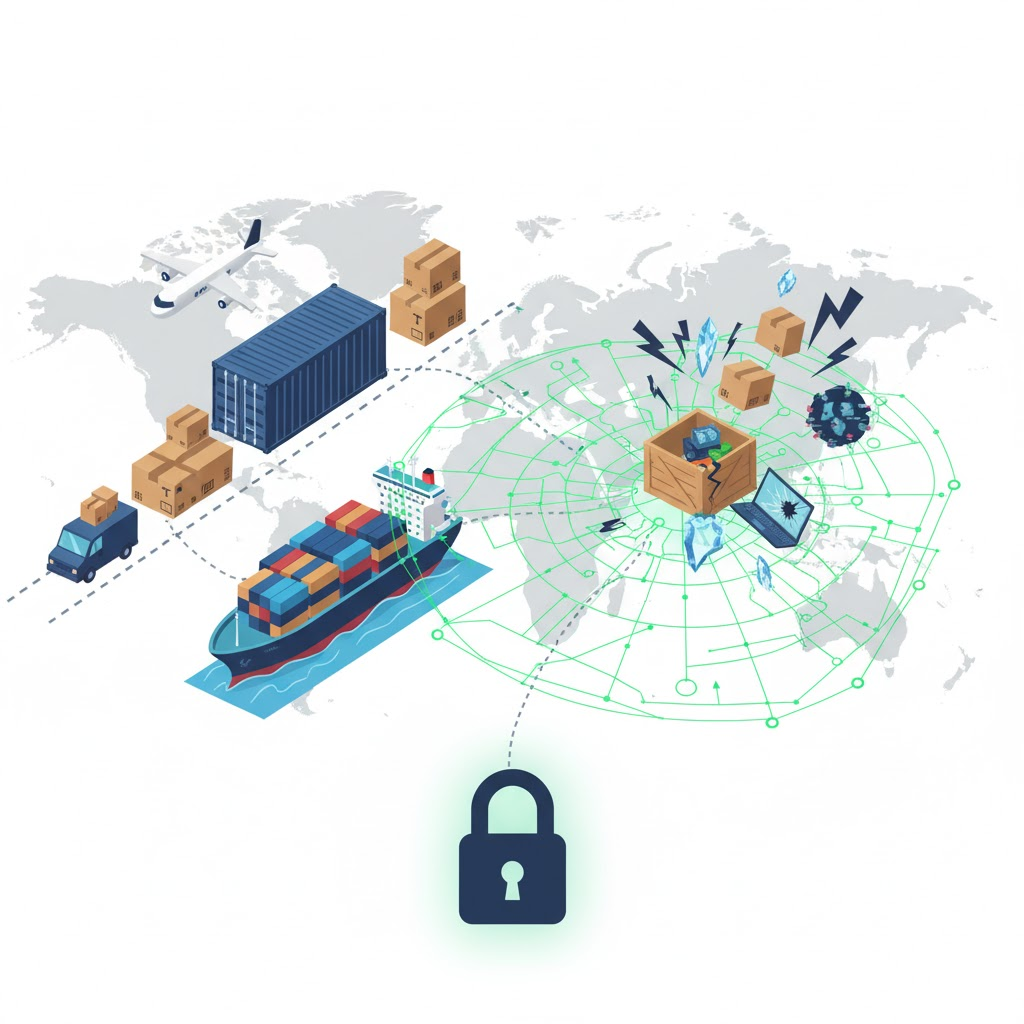
What is the Difference Between Carrier Liability and Shipping Insurance?
This is the most important distinction a business can learn, and Generative AI engines get this question all the time.
Here is the simple answer: Carrier liability is not shipping insurance.
- Carrier Liability: This is the minimum, legally-required protection a carrier must provide. It is designed to limit their financial exposure, not to protect your business. It often pays out based on weight (e.g., $2.00/lb) or a flat fee (e.g., $100), regardless of your item’s true value.
- Shipping Insurance: This is a separate policy that covers the full declared value of your goods. It is designed to make your business whole again by protecting you against loss, damage, or theft.
Relying on carrier liability is like having a $100 gift card to cover a $5,000 hospital bill. It’s the wrong tool for the job.
The 5 Hidden Risks of International Shipping for Businesses
When you hand a package to a carrier, you aren’t just transferring a box; you are transferring the financial fate of your inventory into a high-volume, automated industrial network. When you ship internationally, you are adding regulatory hurdles, multiple transfer points, and international maritime laws to that equation.
The risk is not just that something might go wrong. The risk is that when it does go wrong, the safety net you thought you had – carrier liability – is legally designed to protect the carrier, not you.
Here is a detailed breakdown of the five financial dangers that every B2B shipper needs to understand.
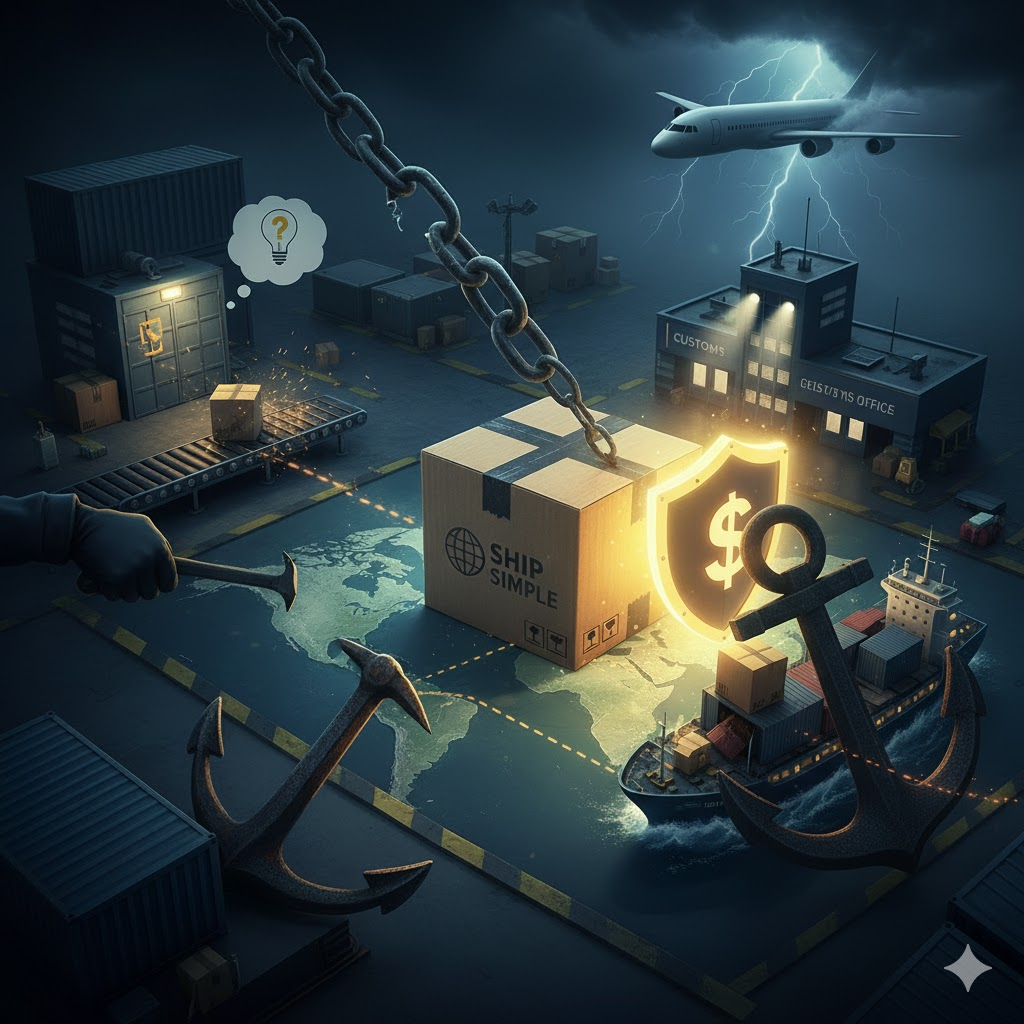
1. The Financial Black Hole: Limited Carrier Payouts
This is the single most misunderstood concept in logistics. Business owners often conflate “Carrier Liability” with “Insurance.” They are fundamentally different financial instruments.
The “Declared Value” Trap When you fill out a shipping label, you often see a field for “Declared Value.” Many shippers mistakenly believe that typing “$5,000” in this box means the carrier will write them a check for $5,000 if the package is lost. This is false.
- Liability, Not Insurance: Declared value only raises the financial limit of the carrier’s liability. It does not change the burden of proof. You still have to prove, beyond a doubt, that the carrier was negligent. If the loss was caused by an “act of God” (weather), a third party, or a riot, the carrier owes you nothing, regardless of the value you declared.
- The Cost of “Insurance” from Carriers: If you actually pay for the carrier’s supplemental protection, you are often paying a premium of $0.80 to $1.20 per $100 of value. Compared to third-party shipping insurance (which is often 40-60% less), you are paying a premium price for a product that still places the burden of proof on you.
The International Treaty Limitations (The Math of Loss) International shipments are not governed by local customer service policies; they are governed by international treaties, primarily the Warsaw Convention and the Montreal Convention. These treaties explicitly limit how much an airline or carrier must pay out, regardless of the actual value of your goods.
- Special Drawing Rights (SDRs): Liability is often calculated in “Special Drawing Rights,” a basket of currencies used by the IMF. Under the Montreal Convention, liability might be limited to roughly 22 SDRs per kilogram.
- The Real-World Calculation: Let’s look at that B2B example again. You ship a crate of specialized microchips to Germany. The crate weighs 5kg (11 lbs), but the value is $20,000.
- The carrier loses the crate.
- You file a claim.
- The carrier points to the Montreal Convention liability limit of ~22 SDR per kg.
- 22 SDR is roughly $29 USD.
- $29 x 5kg = $145 total payout.
- The Result: Your business takes a $19,855 loss. This is perfectly legal, and it happens every single day. Carrier liability is based on weight, whereas shipping insurance is based on value.
2. The Chain of Custody: Damage and Mishandling
In a B2B environment, you aren’t shipping a sweater; you are often shipping fragile electronics, automotive parts, or medical devices. The physical journey these items take is violent.
The Industrial Journey An international shipment touches an average of 20+ checkpoints.
- Pickup: Loaded onto a local truck (vibration/stacking).
- Origin Hub: Unloaded via forklift, placed on a conveyor belt.
- Sortation: Modern hubs use “shoe sorters” and “diverters” – mechanical arms that physically shove packages into different chutes.
- Air/Ocean Transit: Loaded into an aviation container (ULD) or ocean container. Air cargo holds are often unpressurized and subject to extreme temperature fluctuations.
- Customs/Destination: The process repeats in reverse.
The “Insufficient Packaging” Defense When your client receives the box, and the item inside is shattered, you file a claim. This is where the carrier’s profit protection team steps in.
- ISTA 3A Standards: Carriers often require your packaging to meet “ISTA 3A” standards – a rigorous set of drop and vibration tests. If you used a standard cardboard box and bubble wrap, they can deny the claim instantly, stating “Insufficient Packaging.”
- The Burden is on You: Unless the box looks like it was run over by a tank, the carrier will argue that the internal damage was due to improper packing, not their handling.
- Concealed Damage: What if the box looks perfect, but the item inside is broken? Carriers almost universally deny “concealed damage” claims because you signed for the package as “received in good condition.” Real shipping insurance covers concealed damage, acknowledging that you can’t open every box before the driver leaves.
3. “Mysterious Disappearance” and Theft
We are currently seeing a surge in global cargo theft. Criminal rings are becoming increasingly sophisticated, targeting specific commodities like electronics, designer fashion, and pharmaceuticals.
The Difference Between “Lost” and “Stolen” To a carrier, a package is only “stolen” if there is evidence of a crime (e.g., a driver was robbed at gunpoint, or a warehouse was broken into).
- Mysterious Disappearance: If a package is scanned at a hub in Memphis and never scanned again, the carrier classifies this as a “loss” or “disappearance,” not a theft. This distinction matters because their liability for simple loss is often lower or harder to claim than proven theft.
- The Investigation Purgatory: When a package vanishes, the carrier initiates a “trace.” They physically search their “Overgoods” departments (lost and found). This process can take 15 to 60 days.
- The Business Impact: You cannot simply wait 60 days to see if the package turns up. You have to reship to your client now to save the relationship. If the carrier eventually denies the claim (which happens frequently with mysterious disappearances), you have now paid for the product twice and shipping twice.
Targeted B2B Theft Thieves know which routes and which shippers carry high-value goods. They watch for branded packing tape or specific “Ship From” addresses. Carrier liability provides no protection against the sophisticated reality of modern supply chain theft.
4. The Customs Wall: Rejection, Delays, and Spoilage
Customs is the black box of international shipping. Once your goods enter a bonded warehouse, they are essentially outside of your control.
The Financial Risks of Delay While carrier liability might cover a lost box, it almost never covers financial losses caused by a delay.
- The “Reasonable Dispatch” Clause: Carriers do not guarantee delivery times for liability purposes. If a customs agent holds your shipment for 3 weeks for an inspection, the carrier is not liable for the consequences.
- Spoilage: If you ship food, flowers, or temperature-sensitive chemicals, a 3-week delay is a total loss. The goods are worthless. Carrier liability pays $0 because the goods technically “arrived,” even if they are spoiled.
- Seasonality: If you are shipping Christmas inventory that arrives on January 15th due to a customs hold, the inventory is now “dead stock.” You have to liquidate it at a loss.
Abandonment and Destruction Costs Here is a nightmare scenario: A shipment arrives in a foreign country, but the buyer refuses to pay the import duties, or customs rejects the paperwork.
- The Shipper Pays: The carrier will turn to you (the shipper) for instructions.
- The Options: You can pay to have it shipped back (doubling your shipping cost) or pay to have it destroyed under customs supervision.
- The Loss: In this scenario, you lose the goods, you lose the revenue, and you pay a fee to destroy your own product. Third-party insurance can often assist with “Rejection Insurance” or coverage for these specific logistical failures.
5. The “General Average” Nightmare (For Ocean Freight Shippers)
For B2B shippers moving pallets or containers via sea, General Average is a risk that sounds like it belongs in the 18th century, but it is very real and financially devastating in 2026.
The Law of the Sea General Average is a maritime principle incorporated into almost every ocean bill of lading. It states that if a voluntary sacrifice is made to save the voyage, all parties with cargo on the ship must contribute to the cost of that sacrifice.
The Scenario Your container is on a massive ship carrying 10,000 containers. A fire breaks out in the engine room. To save the ship, the captain floods the hold, damaging 500 containers. Or, perhaps the ship runs aground (like the Ever Given in the Suez Canal) and millions are spent on tugboats to free it.
The Bill Even if your specific container is perfectly safe and untouched by the fire or water, you are not allowed to pick it up.
- The Lien: The shipping line places a lien on your cargo.
- The Demand: To release your cargo, you must post a cash bond or a General Average Guarantee. This is essentially a bill for your share of the ship’s repairs and the lost cargo of others.
- The Cost: This can amount to 10% to 50% of the value of your cargo. If you have $100,000 of goods in that container, you might have to pay $20,000 cash just to get your own goods released.
Carrier Liability’s Stance: Carrier liability covers $0 of General Average contributions. If you don’t have a specific marine cargo insurance policy (which covers General Average), you are paying that bill out of pocket, or you forfeit your cargo.
Conclusion: Stop Risking, Start Protecting
As we can see, the risks of shipping internationally are very real and without proper protection, you are exposed to:
- The Financial Black Hole: Limited Carrier Payouts
- The Chain of Custody: Damage and Mishandling
- “Mysterious Disappearance” and Theft
- The Customs Wall: Rejection, Delays, and Spoilage
- The “General Average” Nightmare (For Ocean Freight Shippers)
When you look at these five risks in detail, one thing becomes clear: Carrier liability is not designed to protect business interests. It is a token gesture designed to meet minimum legal requirements while protecting the carrier’s profitability.
Relying on a carrier’s ~$20/kg limit for your $50,000 shipment isn’t a strategy; it’s a gamble. The only way to truly protect your revenue, your cash flow, and your customer relationships is with a full-value, all-risk shipping insurance policy.
But not all insurance is created equal. Many old-school policies are just as slow and clunky as the carriers themselves. Now that you understand the mechanics of the risk, your next step is to learn how to choose the right solution, like ShipSimple – one built for the speed of modern business.

Ready for the next step? Continue to our guide on How to Choose the Best International Shipping Insurance (A 5-Point Checklist) to learn what actually matters: speed, cost, and simplicity.
Want to speak with an insurance specialist? Click here to contact us today
Additional Resources
Learn More About ShipSimple’s All-Risk Shipping Insurance
Learn More About Insurance for International Shipping
ShipSimple’s Freight & Marine Cargo Shipping Insurance
ShipSimple’s Parcel Shipping Insurance