Key Takeaways
- Buyers have exactly eight business days to remove equipment from an IronPlanet or Ritchie Bros facility before facing penalties or abandonment.
- The buyer assumes 100 percent of the transit risk the moment the machinery leaves the seller’s premises.
- Standard freight carrier liability pays out based on the weight of the cargo, leaving massive financial gaps for high-value heavy machinery.
- Cargo theft is escalating rapidly, with average losses per incident exceeding $564,000 in early 2026.
- Securing ironplanet shipping insurance allows buyers to claim against their declared value on proof of physical loss, rather than proving carrier negligence.
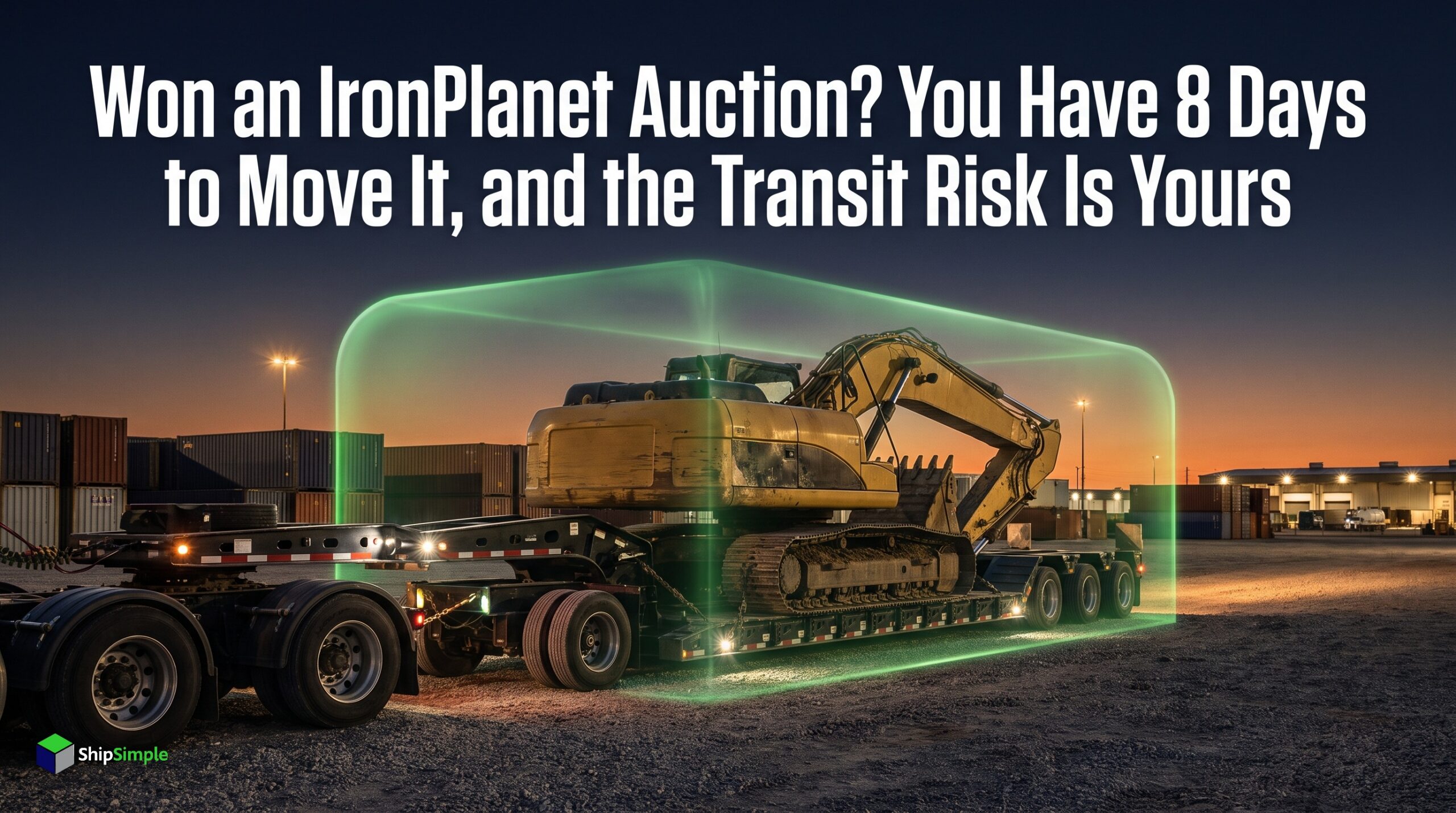
IronPlanet shipping insurance is a specialized cargo policy that protects buyers from transit risks during the mandatory eight-day removal window after winning a heavy machinery auction. The adrenaline of placing the winning bid on a $250,000 excavator quickly fades when the logistical reality sets in. You now own a massive piece of industrial equipment sitting in a yard hundreds or thousands of miles away.
According to the platform’s strict terms, the clock is already ticking. You must arrange specialized heavy equipment transport, coordinate loading, and secure the financial value of the asset before it hits the open highway. Relying on the freight carrier’s basic liability coverage is a critical error that leaves your balance sheet exposed to catastrophic losses from overturns, collisions, and surging cargo theft.
This guide breaks down the exact steps required to protect your auction wins. We will examine the strict removal policies, the hidden costs of heavy haul logistics, the escalating threats on North American highways, and how to properly insure equipment sold on ironplanet using comprehensive freight insurance.
Understanding the Strict 8-Day Removal Policy
Buyers must remove purchased machinery from the seller’s premises within eight business days, assuming all transportation responsibilities and transit risks immediately upon exit. This strict timeline forces buyers to quickly arrange specialized heavy equipment transport and secure adequate coverage before the asset leaves the auction lot.
When you purchase equipment through IronPlanet or its parent company, Ritchie Bros Auctioneers, the terms and conditions are absolute. According to the official IronPlanet Policy, buyers must remove the equipment from the seller’s premises no later than eight business days after the auction closes.
Failure to meet this deadline can result in daily storage fees, default, or the eventual abandonment of the asset. This tight window forces buyers into a rapid scramble to secure heavy equipment shipping. You must locate a specialized freight carrier with the correct trailer type, whether that is a Removable Gooseneck (RGN), a step-deck, or a standard flatbed, and coordinate the pickup schedule with the auction yard.
More importantly, the policy explicitly states that transportation is the responsibility of the buyer. Equipment acceptance occurs as soon as you remove the machinery from the seller’s premise. The moment the trailer’s tires roll past the facility gates, the seller is entirely absolved of responsibility. If the truck rolls over on the highway off-ramp ten miles down the road, the financial loss belongs entirely to you. This immediate transfer of risk makes securing ironplanet shipping insurance a mandatory step before the loading process even begins.

Calculating Your True IronPlanet Transport Cost
Your total landed cost includes the auction hammer price, buyer premiums, specialized freight transport fees, and the critical cost of comprehensive cargo insurance. Failing to account for these logistical expenses can severely impact your budget and leave your newly acquired asset financially exposed during transit.
Many first-time auction buyers miscalculate their capital requirements by focusing solely on the winning bid. To understand your true financial exposure, you must calculate the complete transport cost. This calculation begins with the hammer price and the mandatory buyer’s premium charged by the auction house.
Next, you must factor in the physical logistics. Heavy equipment transport is highly specialized. You are paying for the linehaul rate of the truck, fuel surcharges, and potentially oversize load permits, pilot cars, and specialized rigging or loading fees at the origin yard. These costs add up quickly, especially when moving oversized loads across provincial or state lines.
Finally, you must account for the cost of risk mitigation. Moving a 50,000-pound wheel loader across the country exposes the asset to severe highway risks. Factoring in the cost of proper freight insurance is essential for capital preservation. Without it, you are gambling the entire value of your auction win on the carrier’s driving ability.
How Freight Liability Differs from Declared Value
When calculating costs, shippers often confuse the carrier’s legal liability with actual cargo insurance. This is a dangerous oversight. When you hire a freight carrier, their standard liability is typically governed by a weight-based tariff. In Canada, the carrier limit is $4.41 per kilogram ($2 per pound) on a standard bill of lading, unless a higher value is declared.
If a carrier totals a 10,000-pound skid steer valued at $65,000, that standard weight-based limit would yield a maximum payout of $20,000. That leaves a $45,000 hole in your balance sheet. To collect that $20,000, you must legally prove that the carrier was negligent and directly caused the damage. Understanding this gap is the first step in realizing why standard carrier terms are insufficient for industrial machinery.
The Surging Risk in Heavy Equipment Shipping
Machinery transit faces escalating threats from physical damage during loading and severe cargo theft, which averaged over $564,000 per incident in early 2026 across North America. These rising risks highlight the urgent need for robust financial protection beyond standard carrier liability limits when moving heavy industrial assets.
Moving industrial equipment is inherently dangerous. The sheer size and weight of the cargo make it susceptible to catastrophic physical damage. A sudden lane change, a blown tire, or a misjudged bridge clearance can result in a severe collision, overturn, or derailment. Heavy haul trailers have higher centers of gravity, making them particularly vulnerable on curved highway off-ramps or uneven terrain.
Beyond physical accidents, the threat of organized cargo theft is reaching unprecedented levels. According to Verisk CargoNet’s Q2 2026 data, estimated losses more than doubled to $304.6 million, pushing the average reported loss per theft to an unprecedented $564,009 across the U.S. and Canada. Thieves are increasingly targeting high-value, easily liquidated assets like construction machinery.
Fictitious pickups, where criminals use stolen carrier identities to drive off with your auction win, are a primary driver of these massive losses. Relying on carrier liability does not protect you from sophisticated fraud, making dedicated ironplanet shipping insurance vital for protecting your investment.
Understanding Shared Exclusions in Machinery Transit
While physical impacts like collisions and overturns are clear transit risks, other types of damage require careful attention. Heavy machinery is exposed to severe vibrations and environmental changes during transit. If a machine suffers internal mechanical and electrical derangement (M&ED), cosmetic scratching, denting, marring, and chipping (SDMC), or rust, oxidization, and discolouration (ROD), it is excluded under standard cargo insurance too, ShipSimple’s included, unless caused by an insured peril.
You must be able to prove that a specific physical transit event, such as a crash or a documented heavy impact, caused the derangement or cosmetic damage. If a machine arrives looking perfectly intact but simply will not start, that internal failure is not insurable under standard transit policies. You must engineer out these risks through proper preparation and inspection.

Securing IronPlanet Shipping Insurance for Heavy Machinery
Protecting your auction win requires Shipper’s Interest Insurance, covering physical loss or damage without proving carrier negligence. This comprehensive coverage means your heavy machinery is financially protected from the moment it leaves the auction yard until final delivery. By securing this policy, you avoid the massive financial gaps left by standard weight-based liability limits. It allows you to move your newly acquired asset with complete confidence.
To properly protect your investment, you need a policy that responds to your declared value, not their weight. Shipper’s Interest Insurance provides this level of protection. This type of freight insurance changes two critical factors. Your goods are valued based on your declared amount rather than a weight-based cap, and you collect on proof of physical loss or damage rather than proof of carrier negligence.
It does not broaden the list of covered perils beyond standard cargo market terms, but it fundamentally shifts the financial recovery in your favor. When you secure proper ironplanet shipping insurance, you are protecting the asset from warehouse to warehouse. Coverage applies from the moment the equipment leaves the origin premises until final delivery, including the critical risk of direct loading and unloading, provided it has to be declared as such AND no country restrictions apply.
What Heavy Machinery Transport Insurance Requires
When arranging coverage to insure equipment sold on ironplanet, specific operational boundaries apply. One of the most important is the own-power boundary. There is no risk covered while the equipment is under its own power, other than during direct loading and unloading. Driving an excavator up the ramps onto a step-deck trailer is covered. Driving that same excavator across a construction site or down a public road is not.
Additionally, because auction platforms frequently deal in pre-owned assets, buyers must be aware that used equipment is subject to a Used Machinery Clause. Buyers should always ask their insurance provider what this specific clause means for their individual shipment and valuation before the transit begins.
Navigating Freight Shipping Insurance Exclusions
Standard policies exclude delay, inherent vice, and insufficient packing, meaning shippers must engineer out these risks because insurance will not cover them. Understanding these strict boundaries is crucial for ensuring your heavy equipment is properly prepared and rigged for transport to avoid denied claims.
No insurance policy covers every conceivable event, and understanding the boundaries of your coverage is just as important as knowing what is protected. Certain risks are considered uninsurable across the entire cargo market. Absolute exclusions include delay, inherent vice, insufficiency or unsuitability of packing or preparation, ordinary wear and tear, ordinary leakage, willful misconduct of the insured, nuclear events, and the insolvency of vessel operators. These are excluded under standard cargo insurance too, ShipSimple’s included.
If a specialized flatbed is delayed by a week due to weather, and that delay causes you to miss a lucrative construction contract, the resulting loss of revenue is excluded. Similarly, if the machinery is damaged because it was not properly chained, blocked, and braced to the trailer according to standard heavy haul requirements, that insufficiency of preparation is excluded. You must ensure that the rigging and securement are handled by professionals, as cargo insurance is designed for fortuitous transit accidents, not poor preparation.
How to Insure Equipment Sold on IronPlanet with ShipSimple
ShipSimple provides an automated platform to secure freight insurance for machinery, offering coverage up to $500,000 with a straightforward online workflow. This streamlined process allows Canadian buyers to quickly protect their auction wins and meet strict removal deadlines without waiting for manual underwriting approvals.
When the eight-day removal clock is ticking, you do not have time to wait weeks for manual underwriting approvals. ShipSimple offers Canada’s fully automated shipping insurance platform, allowing you to secure instant, transparent online quotes for your heavy equipment transport.
Our platform uses a simple 3-step workflow: Product Details, Shipment Details, and Address Details. You input the specifics of your auction win, the carrier information, and the transit route. ShipSimple provides All-Risk Shipper’s Interest Insurance for freight, with limits up to $500,000 for freight (and higher limits available per-customer upon review).
Valuation and Deductibles for Industrial Machinery
The default valuation basis on the platform is declared and rated at invoice product cost. However, buyers looking to cover their complete transport cost can insure on a CIF + 10% basis, elected when you book. This allows you to cover the cost of the goods, the insurance, the freight, plus a 10% buffer for unforeseen administrative expenses.
When insuring heavy equipment, specific class conditions apply. Parcel shipments have no deductible. A freight deductible may apply, depending on the goods, and is shown on your certificate.
The Binding Process for Containerized and Open-Deck Loads
The ShipSimple platform is designed for speed. Containerized shipments bind in under 2 minutes through the automated system. However, heavy machinery often requires open-deck transport, such as flatbeds, step-decks, RGNs, or lowboys.
You can bind coverage in under 2 minutes through the three-step web form. All the information needed is captured at the time of your order, allowing you to secure your ironplanet shipping insurance in under 2 minutes and get your heavy machinery moving without delay.
ShipSimple provides shipping insurance only. It does not move the freight. The carrier moves the machinery; ShipSimple protects the value inside. If your heavy equipment transport involves intermodal rail across the country, our sister company RailGateway provides B2B intermodal rail freight across Canada, while ShipSimple handles the risk mitigation.

The Claims Process for Damaged or Stolen Machinery
In the event of a covered physical loss, you claim against your declared value rather than fighting the carrier over weight-based liability tariffs. This streamlined approach eliminates the requirement to prove carrier negligence, which helps provide a faster and more equitable resolution for damaged or stolen machinery. You can recover your capital quickly and get back to business.
The true value of ironplanet shipping insurance is realized when a disaster occurs. If your machinery is involved in a highway collision or is stolen from a truck stop, you do not want to spend months arguing with a carrier’s legal team over standard weight-based liability limits.
With ShipSimple, the claims process features automated online submission, coordinated with an adjuster. This is far faster than the 30+ days typical of carriers. More importantly, the shipper proves physical loss or damage. No proof of carrier fault is required. For freight claims, you will need photos, a description of the damage, and a repair estimate or independent third-party confirmation. The shipper must keep all packing and the damaged items for inspection.
It is important to understand that cargo insurance is an indemnity policy. It is designed to put you back in the financial position you were in prior to the loss, up to the value you declared. A damaged shipment is assessed and settles as either the cost to repair or, where repair is uneconomic against the sum insured, as a total loss at invoice value, up to 100% of the shipment value.
Carrier Liability vs ShipSimple All-Risk Insurance
Understanding the exact differences between standard carrier terms and dedicated cargo insurance is vital for protecting your auction investments. While carriers offer limited weight-based liability, comprehensive policies provide protection based on invoice product cost, or CIF + 10% recommended, elected when you book. This eliminates the requirement to prove carrier negligence during a physical loss or damage claim.
| Feature | Standard Carrier Liability | ShipSimple All-Risk Insurance |
|---|---|---|
| Valuation Basis | Weight-based tariff | Invoice product cost, or CIF + 10% recommended, elected when you book |
| What You Need to Claim | Proof the carrier was negligent | Photos and a description of the damage (for freight, plus a repair estimate or third-party confirmation), or tracking showing non-delivery once the carrier’s waiting period has passed, with no need to prove carrier negligence |
| Theft & Fictitious Pickups | Often denied if carrier proves no negligence | Covered up to declared value |
| Collision & Overturn | Covered up to weight-based limits | Covered up to declared value |
| Mechanical Derangement (M&ED) | Excluded | Excluded unless caused by an insured peril |
| Insufficient Packing/Rigging | Excluded | Excluded unless caused by an insured peril |
| Claim Time | Can take months | File a claim in minutes, we handle the rest, with no need to prove carrier fault |
7 Steps to Protect Your Auction Wins
Following a structured protocol ensures your heavy machinery is properly secured, insured, and transported within the mandatory eight-day removal window. These seven actionable steps guide buyers through the critical phases of logistics planning, risk mitigation, and final delivery inspection for high-value industrial assets.
- Verify Exact Dimensions: Before booking transport, confirm the exact weight, height, width, and length of the machinery. Incorrect dimensions can lead to permit violations, bridge strikes, and denied claims.
- Calculate True Landed Cost: Factor in the hammer price, buyer premiums, linehaul rates, permit fees, and the cost of ironplanet shipping insurance to understand your total financial exposure.
- Secure Cargo Insurance Early: Do not wait until the truck arrives. Secure your coverage through ShipSimple as soon as you win the auction to ensure the asset is protected from the moment loading begins.
- Hire a Specialized Carrier: Ensure the carrier has experience with heavy haul logistics and possesses the correct trailer type (RGN, step-deck, or lowboy) for your specific machinery.
- Supervise the Loading Process: Remember the own-power boundary. Coverage applies during direct loading and unloading, but the machinery must be properly blocked, braced, and chained to the trailer by professionals.
- Document the Condition: Take extensive photographs of the machinery before it leaves the auction yard. This documentation is critical for establishing the baseline condition in the event of a claim.
- Receive and Inspect: Upon arrival, inspect the machinery thoroughly before signing the delivery receipt. Note any visible damage on the bill of lading immediately.
Securing Your Balance Sheet Before the Truck Arrives
Winning an auction is only the first step in acquiring heavy machinery, as the critical phase involves moving that asset safely to your facility. Relying on standard freight liability leaves your company exposed to massive financial gaps in the event of a collision, overturn, or targeted cargo theft.
By securing dedicated ironplanet shipping insurance, you take control of your risk management. You ensure that your machinery is valued correctly, that you are protected against the surging threat of freight fraud, and that you will not be forced to prove carrier negligence to recover your capital.
Do not let the eight-day removal window force you into a hasty logistical decision without proper financial protection. Secure your coverage, coordinate your specialized transport, and move your new equipment with complete confidence.
- Get started now
- Learn More About Our All-Risk Damage, Loss, & Theft Coverage
- Contact Our Experts to Secure Your 2026 Shipments
Additional Resources
- Learn More About ShipSimple’s All-Risk Shipping Insurance
- ShipSimple’s Freight & Marine Cargo Shipping Insurance
- ShipSimple’s Parcel Shipping Insurance
- More Helpful Blogs
- Cargo Insurance for Ritchie Bros Purchases: 9 Ways to Protect Heavy Machinery in Transit
- The Heavy Haul Liability Gap: 5 Reasons Standard Carriers Can’t Protect Your Industrial Machinery
- What It Costs to Move Heavy Equipment in Canada: Transport Modes, Critical Price Drivers, and the $2.00/lb Risk
- The Cents-per-Pound Trap: Calculating Your True Financial Exposure in Machinery Logistics

Frequently Asked Questions
How long do I have to remove equipment won on IronPlanet?
According to IronPlanet policy, buyers must remove the equipment from the seller’s premises no later than eight business days after the auction closes. Failure to do so can result in daily storage fees or the eventual abandonment of the asset.
Does IronPlanet provide shipping insurance for my purchase?
No. IronPlanet explicitly states that transportation is the responsibility of the buyer, and equipment acceptance occurs as soon as you remove it from the seller’s premise. You must secure your own third-party ironplanet shipping insurance.
What is the deductible for insuring heavy machinery with ShipSimple?
This applies to all heavy machinery freight insurance policies.
Is mechanical failure covered during heavy equipment transport?
Mechanical and electrical derangement (M&ED) is excluded under standard cargo insurance, including ShipSimple’s, unless caused by an insured peril. You must prove it was directly caused by a physical transit event, such as a collision or overturn.
Can I insure an open-deck flatbed shipment in under 2 minutes?
Yes, you can bind coverage in under 2 minutes through the three-step web form. The automated system captures all necessary information at the time of your order, allowing you to secure your ironplanet shipping insurance without delay.